
Running · Injury prevention
Training for the Auckland Marathon? The four injuries we see most — and how to stay ahead of them
Nine weeks out from the Harbour Bridge, something starts to hurt. Here is how to work out what it is, what to do about it this week, and why stopping running is usually the wrong answer.
The short answer
The four running injuries we treat most in the lead-up to the Auckland Marathon are patellofemoral pain (pain at the front of the kneecap), medial tibial stress syndrome (shin splints), Achilles tendinopathy and plantar heel pain. Almost all of them share a single cause: training load rising faster than your body's capacity to absorb it. If you catch them in the first two weeks, most can be managed without stopping running — by changing the load rather than removing it.
Why the niggle showed up now
By the start of September, most people running the Auckland Marathon are eight or nine weeks out and deep into the biggest weeks of their build. Long runs have stretched past two hours. You've added a tempo session. You've probably added hills, because you've seen the elevation profile of the Harbour Bridge and you know what's coming at kilometre eight.
Then something starts talking to you. It's usually quiet at first — sore for the first kilometre, fine after that, sore again on the stairs at work. It's the kind of thing that's easy to file under "just part of marathon training".
Sometimes it is. Often it isn't. And the difference between those two matters more in September than at any other point in the year, because you no longer have the weeks to spare.
Nearly every running injury we see in this window comes down to one idea, and it's worth understanding because it changes what you do about it. Your tissues — tendon, bone, muscle, fascia — have a certain capacity to absorb load. That capacity grows, but it grows slowly, and it grows more slowly than your cardiovascular fitness does. Your lungs and your legs adapt on different timelines. Injuries happen in the gap.
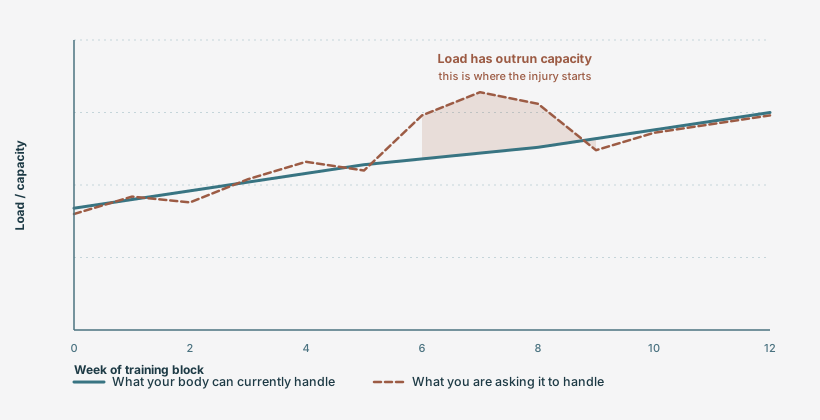
This is why "how many kilometres is too many?" has no answer. There is no universal number. There is only your capacity, and how fast you're asking it to change.
Where does it hurt?
Four problems account for the large majority of what walks through our door between September and race day. They're distinguishable by location more than anything else, which is genuinely useful, because it means you can narrow things down before you see anyone.
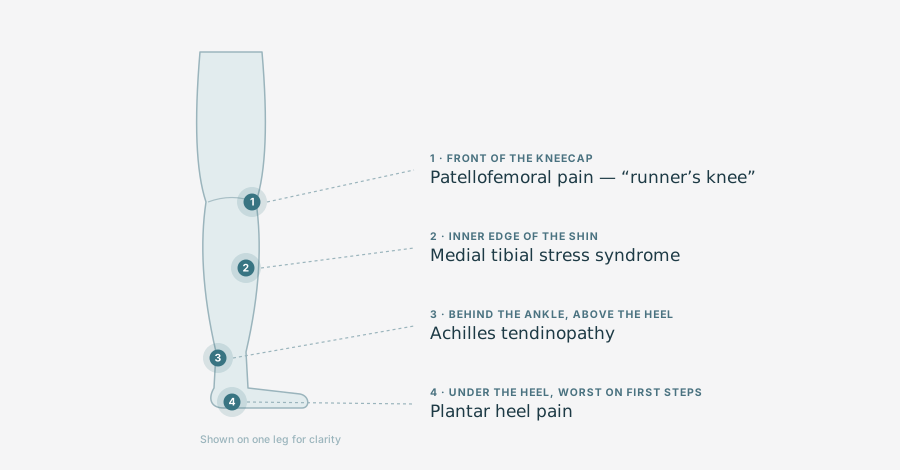
1. Pain at the front of the kneecap — patellofemoral pain
- Feels like
- A dull ache around or behind the kneecap. Worse going down stairs than up. Often grumbles after sitting for a long time — the classic sign is a sore knee walking out of a cinema or a long meeting.
- What's happening
- The joint between your kneecap and thigh bone is taking more load than it's currently set up to take. Hip and quad strength, running cadence and a sharp jump in downhill or long-run volume all feed into it.
- This week
- Keep running, but flatten the route and shorten the stride slightly. Downhill running is the biggest aggravator, so if your long run finishes down Mount Eden Road, reverse it.
- Get it seen if
- It's swelling, giving way, or locking. Those are different problems.
2. Pain along the inner edge of the shin — medial tibial stress syndrome
- Feels like
- An ache spread along the inner border of the shin bone, usually over a hand's width or more. Sore at the start of a run, sometimes eases, returns afterwards and into the evening.
- What's happening
- Bone responding to load faster than it can remodel. It sits on a spectrum, and the far end of that spectrum is a stress fracture — which is why this one deserves respect.
- This week
- Drop volume rather than stopping. Calf strength work matters more here than almost anything else. Check your shoes — if they've done more than about 700km, they've done their job.
- Get it seen if
- The pain narrows to a small, specific spot you can cover with a fingertip, hurts at rest or at night, or hurts when you hop. Stop running and call us that week.
3. Pain behind the ankle, just above the heel — Achilles tendinopathy
- Feels like
- Stiff and sore for the first few minutes of a run, then warms up and feels fine, then stiffens badly the next morning. Tender to squeeze between finger and thumb.
- What's happening
- The tendon has been asked to store and release more energy than it's conditioned for. Hills and speed work are the usual triggers, which is exactly what people add in September.
- This week
- This is the one where complete rest actively works against you. Tendons need load to adapt — they just need the right amount. Heavy, slow calf raises are the mainstay of the evidence here, and they need to be genuinely heavy.
- Get it seen if
- You felt a sudden sharp snap or pop, or you can't push off at all. That's urgent.
4. Pain under the heel, worst on the first steps of the day — plantar heel pain
- Feels like
- Sharp, focal pain under the heel with the first few steps out of bed, easing over five or ten minutes, returning after long periods of standing.
- What's happening
- Irritation where the plantar fascia attaches to the heel bone. Calf tightness, footwear changes and a spike in time on your feet all contribute.
- This week
- Don't go barefoot on hard floors first thing. Calf and foot strengthening beats stretching alone. A temporary heel wedge can take the edge off while the tissue settles.
- Get it seen if
- There's numbness or pins and needles in the foot, or the pain is in the back of the heel rather than underneath it.
How to tell a niggle from an injury
This is the single most useful thing you can learn to do yourself, and it takes 24 hours.
Run as normal, then pay attention to two things. First, does the pain get worse as the run goes on, or does it warm up and settle? Second, and more importantly, how do you feel the next morning?
A useful working rule, and the one we give runners in the clinic: pain that stays at or below about 3 out of 10, doesn't get worse during the run, and has settled back to baseline by the next morning is a niggle you can train through while you address the cause. Pain that climbs during the run, or is still elevated 24 hours later, is telling you the load exceeded the capacity. That one needs the load changed now, not in a fortnight.
The transitional step, if you're not ready to book
Try the 24-hour check on your next two runs and write down the numbers. Bring that to an appointment and you have given us half the diagnosis before you've sat down. Runners who arrive with two weeks of notes get to a plan considerably faster than runners who arrive with "it's been sore for a while".
You probably don't need to stop running
This is the fear that keeps people out of the clinic in September, and it's the reason niggles turn into races missed. People don't come in because they're afraid we'll tell them to stop.
We understand the arithmetic. You've done eight weeks. Stopping now feels like throwing them away, and there isn't time to rebuild.
So here is the honest position: for three of the four problems above, complete rest is not the treatment, and for Achilles tendinopathy it's counterproductive. What almost always works is relative rest — keeping the running that doesn't provoke symptoms, removing the specific thing that does, and adding the strength work that lifts your capacity line. Losing the hill session for a fortnight costs you very little. Losing six weeks to a stress fracture costs you the race.
What we'd do if you came in tomorrow
Name it properly
A physical assessment — how it behaves under load, what reproduces it, what settles it. Most running injuries are diagnosed by history and examination rather than by scans, and an accurate name changes the plan completely. "Shin pain" and "a bone stress reaction" get handled very differently.
Change the load, not the sport
We work out which specific session is doing the damage and adjust that one, rather than cutting everything. Usually it's a single variable: the hills, the pace of the long run, or how quickly the weekly volume climbed. You keep training.
Lift the capacity line
Two or three strength exercises, loaded properly, done consistently. This is the part that stops it coming back — and it's the part that most runners skip, because it isn't running. Nine weeks is plenty of time to make a real difference to tendon and bone tolerance.
We're an ACC-registered provider, so if your injury qualifies, an accepted claim is subsidised — an ACC initial consultation is $65 and follow-ups are $55. You don't need a GP referral to see us, and we can lodge the claim in the appointment.
When to stop and get it looked at
Stop running and get assessed this week if any of these apply
Pain that narrows to a single point on a bone you can cover with a fingertip · pain at rest or waking you at night · pain that makes you limp · a joint that swells, locks or gives way · a sudden sharp snap or pop during a run · numbness, pins and needles, or a foot that feels weak · pain that has not improved at all after two weeks of reduced load.
None of these mean your race is over. Several of them mean it will be if they're ignored for another three weeks.
Race day and the week after
The marathon starts on King Edward Parade in Devonport at 6:00am, the half at 6:50am, and both cross the Harbour Bridge before the courses split near Westhaven. The full continues out along the waterfront to St Heliers and back to Victoria Park. It's a fast, flat course with one genuine climb in it, and the bridge comes early enough that most people take it harder than they planned.
Two things reliably cause problems afterwards. The first is the descent off the bridge — if your knees have been grumbling, that's where they'll tell you about it, so run it controlled. The second is the week after, when people either stop completely and seize up, or go straight back to running because they feel fine on adrenaline. Neither works well. Easy movement, then a gradual return over two to three weeks.
Questions we get asked
Should I stop running if I have shin splints?
Usually not completely. Most cases of medial tibial stress syndrome respond to reducing volume and adding calf and foot strength work rather than stopping. The exception is if the pain has narrowed to a small specific point on the bone, hurts at rest or at night, or hurts when you hop — that pattern suggests a bone stress injury and you should stop running and be assessed that week.
How do I know if my running pain is serious?
Run as normal and check two things: whether the pain worsens during the run, and how it feels 24 hours later. Pain that stays at or below about 3 out of 10, does not worsen during the run, and has settled by the next morning is generally safe to train through while you address the cause. Pain that climbs during the run or is still elevated the next morning means the load needs to change now.
Do I need a GP referral to see a physio for a running injury in New Zealand?
No. You can book directly with a physiotherapist in New Zealand without a referral. Physio Impact is an ACC-registered provider, so if your injury qualifies for an accepted ACC claim the cost is subsidised, and we can lodge the claim during your appointment.
How much does physio cost for a running injury in Auckland?
At Physio Impact an ACC initial consultation is $65 and an ACC follow-up is $55. Without an ACC claim, a private initial consultation is $115 and a follow-up is $95. Full pricing is on our pricing page.
When is the 2026 Auckland Marathon?
The Barfoot & Thompson Runaway Auckland Marathon is on Sunday 1 November 2026. The marathon starts at 6:00am and the half marathon at 6:50am, both from King Edward Parade in Devonport, with the finish at Victoria Park.
Is it too late to fix a running injury eight weeks before a marathon?
For most soft-tissue and load-related problems, no. Eight to nine weeks is enough time to meaningfully change tendon and muscle capacity, provided the aggravating load is adjusted early. Bone stress injuries are the exception and need longer, which is why the fingertip-point pain pattern should be assessed quickly rather than watched.
Nine weeks is enough time
Get it named before it costs you the race.
Bring us the niggle while it is still a niggle. Most runners who come in during September keep training through the whole build — they just train slightly differently for a fortnight. We are ACC-registered and you do not need a referral.

Amy graduated BHSc (Physio) in 2011 and has spent the years since on diagnostics, biomechanics and sports-specific rehab. She is a Certified Mulligan Practitioner, works extensively with surgical rehabilitation, and competes as a horse rider outside the clinic. She sees runners at the Eden Terrace clinic.