
Treatment · What to expect
Does dry needling actually work? An honest answer
It's the question I'm asked more than any other, usually by someone who has been offered it and isn't sure whether it's real. Here is the answer I give in the clinic, including the parts that don't sell it.
The short answer
Yes — for the right problem, and not for as long as most people hope. The evidence supports dry needling for short-term reduction in muscle pain and short-term improvement in range of movement. What it does not do is fix the reason the muscle became overloaded. Used on its own it is a temporary reset. Used to open a window for loading and strengthening, it is genuinely useful. If a clinic is needling you every week for months with no plan for what happens next, ask why.
First, what we're actually aiming at
When a muscle has been overloaded or held in one position for long enough, small bands of fibres can get stuck in a shortened, contracted state. You can usually feel them — a rope or a knot running through the muscle that's noticeably firmer than the tissue around it. Press on one and it often reproduces the exact pain you came in complaining about, sometimes in a spot some distance away.
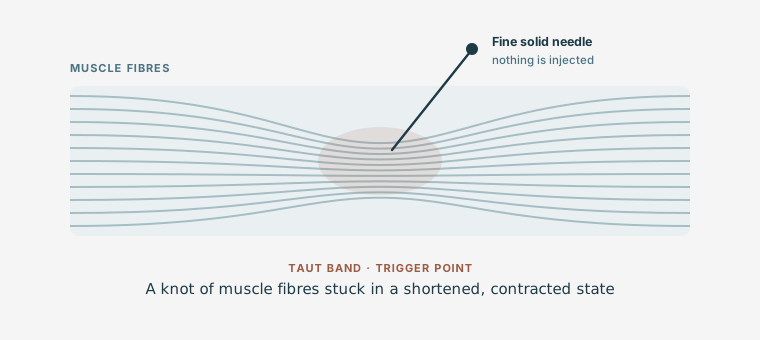
That's the target. A very fine needle goes into that band. Sometimes the muscle gives a brief involuntary twitch as it does. Then the needle comes out, usually within seconds.
The name is unhelpfully clinical. "Dry" simply distinguishes it from an injection — nothing goes in, which is the first thing most people want to know.
So does it work? The honest version
Here's where I'd rather give you a useful answer than a comfortable one.
The evidence supports dry needling for short-term reduction in muscle pain and short-term improvement in range of movement. That effect is real, it's reasonably consistent across studies, and in the clinic it's often immediate — people stand up and can turn their neck further, or squat deeper, within a minute.
Two honest caveats sit alongside that. The first is that the quality of the research is mixed; needling is difficult to blind properly, so the placebo component is genuinely hard to separate out. The second is more practically important: the effect is short-lived on its own. Days, sometimes a couple of weeks. Needling does not fix the reason the muscle became overloaded in the first place.
Which brings me to how I actually think about it. Dry needling isn't a treatment. It's a window. For twenty minutes to a few days, a muscle that was guarding and painful is quieter and moves further. What you do inside that window is what determines whether anything changes permanently. Load it, strengthen it, and change whatever was overloading it, and the window is enormously valuable. Do nothing, and the window closes and you're back next week paying for the same session.
If a clinic is needling you every week for months with no plan for what happens after, that's a fair thing to ask questions about.
Three things dry needling is not
- It isn't releasing toxins. There's no toxin. The most plausible mechanisms are mechanical disruption of the contracted band and changes in how the nervous system processes input from that area.
- It isn't a cure for anything. It changes muscle tone and pain sensitivity for a while. That's a genuinely useful thing to be able to do, and it's also the whole of what it does.
- It isn't for everyone. Some people don't respond. Some people find it unpleasant enough that the stress outweighs the benefit, and for them it's the wrong tool — there are others.
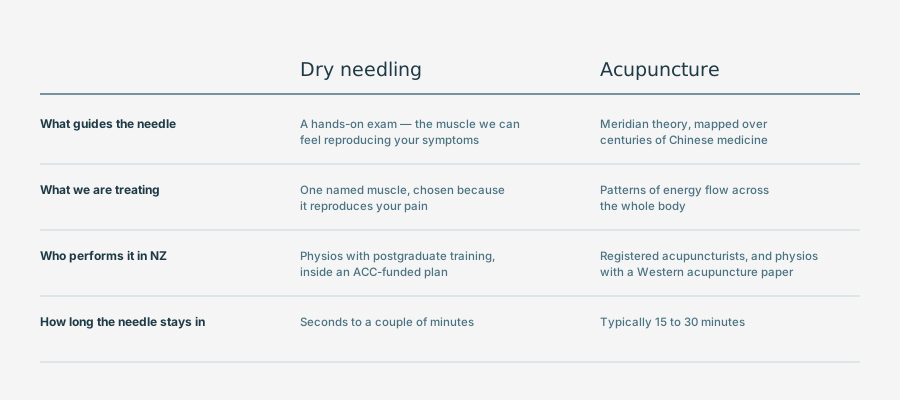
Is dry needling the same as acupuncture?
The needles are near enough identical. Everything about how we decide where they go is different.
What it actually feels like
People brace for a sharp sting. That's usually not what happens.
You often don't feel the needle enter the skin at all — it's far finer than anything you've had blood taken with. What you do feel, when we reach the taut band, is a deep dull ache or a strong cramping sensation. Some people describe it as satisfying in the way that pressing hard on a knot is satisfying. If the muscle twitches, that's a quick involuntary jump that's over before you've registered it.
Afterwards, expect the area to feel bruised or heavy for anywhere from a few hours to two days. That's normal and not a sign anything went wrong. Some people get a small bruise. Occasionally people feel briefly light-headed or tired — tell us if you do, and we'll sit you down.
What happens in a session
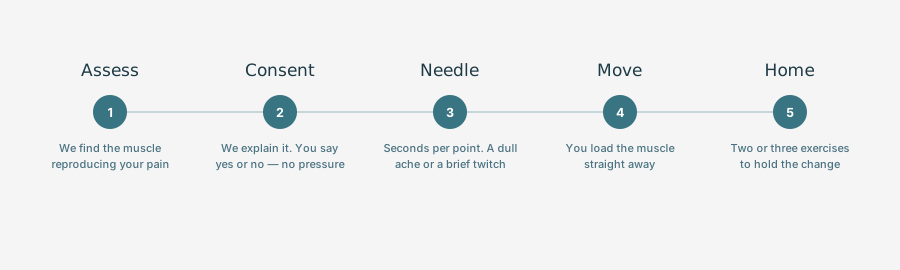
We test whether it's even the right problem
Needling only makes sense if a muscle we can feel is reproducing your symptoms. If your problem is a joint, a tendon under load, or a nerve, needling that muscle won't do much. Working that out is the appointment; the needle is a tool we may or may not reach for.
You decide, and you can say no
We explain what we're proposing and why, and you consent to it or you don't. Declining needling doesn't leave you without options — hands-on work, loading and exercise do the heavy lifting regardless.
You use the window straight away
You'll be moving and loading that muscle within the same appointment, while it's quiet, and you'll leave with two or three things to do at home. This is the part that converts a short-term change into a lasting one.
Who shouldn't have it
Dry needling has a good safety record in trained hands, and serious adverse events are rare. Single-use sterile needles are disposed of after every point. Still, tell us before we start if any of the following apply, because they change what we do:
- You're on blood-thinning medication, or have a bleeding disorder
- You have a compromised immune system, or an infection or wound over the area
- You're pregnant — it isn't ruled out, but some areas are avoided
- You have a metal allergy, a pacemaker, or lymphoedema in that limb
- You have a genuine needle phobia — this is a real reason to choose something else, and nobody will push you
One risk worth naming
Needling over the ribcage, upper back or shoulder blade carries a small risk of puncturing a lung — a pneumothorax. It is rare and the technique for avoiding it is a core part of postgraduate training, but you're entitled to know it exists. If you have chest pain or shortness of breath in the hours after needling over the trunk, seek medical attention and mention that you've had needling.
Does ACC cover dry needling?
Dry needling isn't billed as a separate item. It's one of the techniques included within a physiotherapy consultation, so if you have an accepted ACC claim for the injury, the appointment is subsidised at the standard rate — $65 for an ACC initial consultation and $55 for a follow-up. Without a claim, private rates apply ($115 initial, $95 follow-up). You don't need a GP referral, and we can lodge an ACC claim during the appointment where the injury qualifies.
Questions we get asked
Does dry needling hurt?
Most people do not feel the needle enter the skin, because it is far finer than a needle used for injections or blood tests. What you feel when the needle reaches the taut band is a deep dull ache or a cramping sensation, and sometimes a brief involuntary twitch of the muscle. Afterwards the area commonly feels bruised or heavy for a few hours up to two days.
What is the difference between dry needling and acupuncture?
The needles are essentially the same. The reasoning differs. Dry needling is guided by a hands-on physical examination and targets a specific muscle that reproduces your symptoms, with the needle usually staying in for seconds to a couple of minutes. Traditional acupuncture is guided by meridian theory and treats patterns across the body, with needles typically left in for 15 to 30 minutes.
How long do the effects of dry needling last?
On its own, usually days to a couple of weeks. Dry needling reduces muscle pain and improves range of movement in the short term but does not address why the muscle became overloaded. Lasting change comes from using that window to load and strengthen the area, which is why we always pair it with exercise.
Does ACC cover dry needling in New Zealand?
Dry needling is not billed separately. It is one technique used within a physiotherapy consultation, so an accepted ACC claim subsidises the appointment at the standard rate. At Physio Impact that is $65 for an ACC initial consultation and $55 for an ACC follow-up. Private rates are $115 initial and $95 follow-up.
Who should not have dry needling?
Tell your physiotherapist before starting if you take blood-thinning medication or have a bleeding disorder, have a compromised immune system or an infection over the area, are pregnant, have a metal allergy, pacemaker or lymphoedema in that limb, or have a needle phobia. Needling over the ribcage, upper back or shoulder blade carries a small risk of pneumothorax, which trained practitioners are specifically taught to avoid.
Can I exercise after dry needling?
Yes, and we encourage it. Loading the muscle while it is settled is what turns a short-term change into a lasting one. Expect the area to feel bruised or heavy for up to two days, so keep intensity moderate for the first 24 hours rather than testing it with a maximal session.
Straight answers, no upsell
Not sure whether needling is right for you?
Come in and we will work out what is actually driving your symptoms first. If needling helps, we will explain why and you can decide. If it will not, we will tell you that too — and we will show you what will.

Patrick is a co-founder of Physio Impact and a high-performance, sports-specific physiotherapist. He holds a postgraduate certificate in acupuncture and has spent 15 years in elite gymnastics, including two Commonwealth Games and five World Championships. He works with international athletes and sports teams alongside his clinic caseload.