
Running · Recovery
The week after a marathon: what to actually do with your legs
You crossed the line. Everything hurts, you have no idea what is normal, and somebody has already asked what your next race is. Here is what the first ten days should actually look like.
The short answer
For the first 48 hours, walk, eat and sleep. Do not run. Days three to five, cross-train but still no running. Your first easy run is day six to ten, twenty to thirty minutes, flat and conversational. Rebuild to about half your normal weekly volume over weeks two and three, all easy. The catch is that your aerobic fitness recovers faster than your tendons and bones do, which is why post-marathon injuries turn up in week three, not week one.
What is normal in the first 48 hours
You will be sore in places you did not train. Quads that scream going down stairs, calves that seize if you sit still for an hour, feet that feel bruised on the sole. All of that is ordinary and all of it settles.
A few other things are ordinary and surprise people anyway. Your legs may swell, particularly the ankles, for two or three days. You may sleep badly on the Sunday night despite being exhausted. You may feel flat, teary or oddly deflated by Tuesday. A hard marathon is a genuine physiological stress and the mood dip that follows it is well recognised. You may also pick up a cold in the fortnight afterwards, which is common enough that most endurance coaches plan around it.
What is not ordinary is pain in one leg and not the other, pain that is sharp rather than aching, or anything that makes you limp. Soreness is symmetrical and dull. Injury tends to be neither.
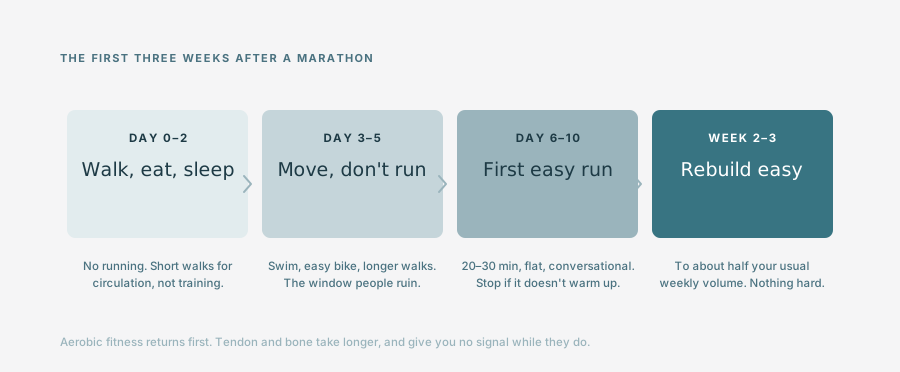
The first ten days
- Day 0–2
- Walk. Not as training, but for circulation. Ten or fifteen minutes a few times a day beats either lying still or going for a hike. Eat properly and carbohydrate-heavily for the first 24 hours, keep drinking, and sleep as much as you can get away with. Sleep is the only recovery intervention with an effect size worth the name.
- Day 3–5
- Still no running. Swim, cycle easy, walk further. If you want to move, move in a way that does not involve your legs absorbing impact. This is the window where people do the damage, because the soreness has faded and they feel fine.
- Day 6–10
- First run: twenty to thirty minutes, conversational, flat. If anything hurts in the first kilometre and does not warm up, walk home and give it another three days. There is no prize for the first post-race run.
- Week 2–3
- Rebuild to roughly half your pre-race weekly volume, all of it easy. No tempo, no intervals, no hills. Your cardiovascular system will feel ready a long time before your tendons and bones do, and that gap is where the post-marathon injuries live.
Why the gap between feeling fine and being fine
This is the part worth understanding, because it explains why the sensible-feeling thing is often wrong.
Aerobic fitness recovers quickly. Within a week most people could, in cardiovascular terms, run a decent session. Connective tissue does not work on that timeline. Tendon and bone take substantially longer to recover from a 42km impact load, and neither gives you a useful signal while they are doing it. There is no soreness that tells you your tibia is still remodelling.
So you feel recovered, you train accordingly, and the thing that breaks three weeks later is a tendon or a bone rather than a muscle. In our clinic the post-marathon presentations cluster in the third and fourth week after the race, almost never in the first.
A rule that works
Give yourself one easy day for every mile raced, which is about 26 days before any hard session. It is an old coaching heuristic rather than a research finding, and it is deliberately conservative, but it errs in the direction that costs you nothing. Easy running throughout is fine and encouraged.
What needs looking at rather than waiting out
Get assessed, or seek urgent medical care, if any of these apply
Urgent, same day. Pain, swelling, warmth or redness in one calf only, particularly with any shortness of breath or chest pain. Urine that is cola-coloured, or passing very little urine, especially with severe widespread muscle pain. Confusion, fainting or a fever that climbs.
Book in this week. Pain that narrows to a point on a bone you can cover with a fingertip · pain that makes you limp · a joint that swells or gives way · numbness or pins and needles · soreness that has not improved at all by day seven.
The one-sided calf is the one to take seriously. A long race, followed by a long drive or a flight, followed by sitting still is a recognised combination, and a calf that is painful, warm and swollen on one side only is not a training niggle. That is an emergency department conversation, not a physio one.
The small things people ask about
- Black toenails. Blood under the nail from repeated impact. Usually painless and usually resolves on its own, though the nail may lift over a few months. If it is throbbing and tense, get it looked at, because the pressure can be released.
- Ice baths. They reduce soreness in the short term. They also blunt some of the adaptation you earned, which matters in training and does not matter at all now. After a goal race, use them if you like them.
- Compression socks. Reasonable evidence for reduced soreness and swelling in the days after. Harmless, cheap, worth it if you find them comfortable.
- Massage. Lovely, and best left until the acute soreness has eased, so around day three or four rather than Sunday afternoon.
- Stretching it out. Gentle movement yes, aggressive stretching of a muscle that has just been through 42km no. It does not speed anything up.
Thinking about the next one
If you are already looking at an autumn target, the honest answer is that the base you built for this one is an asset and you should not waste it by rushing back. Three easy weeks costs you very little fitness and protects the twelve weeks you just banked.
And if the race did not go the way you wanted, resist entering something else in the next fortnight while the disappointment is still fresh. That decision is almost always better made in December than on the Sunday night.
Questions we get asked
How long should I wait to run after a marathon?
Most people should not run at all for the first five days, then do a short easy run of twenty to thirty minutes somewhere between day six and day ten. Rebuild to roughly half your pre-race weekly volume across weeks two and three, keeping everything easy. Hard sessions are best left until around three to four weeks after the race.
Is it normal to feel sore for a week after a marathon?
Yes. Muscle soreness peaking at 24 to 72 hours and easing over five to seven days is normal, and so is swelling in the feet and ankles for a couple of days. What is not normal is pain on one side only, sharp rather than aching pain, or anything that makes you limp.
Why do I feel flat and emotional after a marathon?
A marathon is a significant physiological stress, and a dip in mood in the days afterwards is well recognised among endurance athletes. It usually lifts within a week or two. Picking up a cold in the fortnight after a race is common for the same underlying reason.
When should I worry about calf pain after a marathon?
Calf pain, swelling, warmth or redness in one leg only, particularly after a long drive or flight, and especially alongside breathlessness or chest pain, needs urgent medical assessment the same day rather than a physiotherapy appointment. Ordinary post-race calf soreness is dull, affects both legs and eases with gentle walking.
Do ice baths help marathon recovery?
They reduce muscle soreness in the short term. They also blunt some of the training adaptation you get from hard sessions, which matters during a training block but does not matter after a goal race. After a marathon, use them if you find them helpful.
Can I book a massage straight after a marathon?
Better to wait until around day three or four, once the acute soreness has started to ease. A deep massage on heavily inflamed muscle on race afternoon tends to be more uncomfortable than useful.
Three weeks, not three days
If something still hurts at day ten, get it looked at.
Most post-race niggles settle on their own. The ones that do not are usually the ones people train through because the marathon is finished and they assume it no longer counts. We are ACC-registered and you do not need a referral.
Patrick is a co-founder of Physio Impact and a high-performance, sports-specific physiotherapist. He holds a postgraduate certificate in acupuncture and has spent 15 years in elite gymnastics, including two Commonwealth Games and five World Championships. He works with international athletes and sports teams alongside his clinic caseload.